

Showing posts with label events. Show all posts
Showing posts with label events. Show all posts
"Culture Analytics Beyond Text: Image, Music, Video, Interactivity and Performance," March 21-24 workshop at UCLA
#cultureanalytics2016
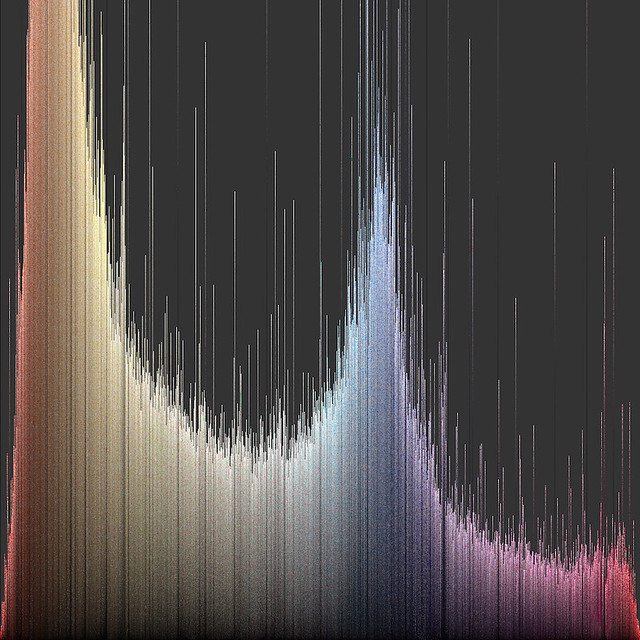
1,000,000 slices from 100,000 images shared on Twitter in Los Angeles during summer 2013. They are visualized as hue histogram vertically sorted by brightness. Author: Damon Crockett.
Workshop 1 of Culture Analytics Institute, UCLA, March - May 2016:
Program and abstracts:
Culture Analytics Beyond Text: Image, Music, Video, Interactivity and Performance
28 speakers; 100 people registered to attend.
Summary:
"This workshop focuses on developing computational and mathematical techniques for the analysis of large sets of cultural artifacts beyond text, and includes considerations of material and graphic design, architecture, fashion, interactive media, games, film, photography, music, painting, performance, and the kinesthetic dimensions of culture. The analysis of audio and visual data requires a different set of quantitative techniques than those devised for textual analysis. This challenge has become all the more acute, as every day individuals and institutions produce and publish hundreds of millions of digital cultural artifacts that are not text. The big data revolution is not only a text-based one, and these enormous new resources of non-text culture require equally revolutionary techniques for meaningful analysis.
The event will highlight novel methods for examining the multidimensional aspects of these cultural expressive forms. Aspects include structural configuration, dynamics in time and space, the changing social implications of artistic production and reception, and the cognitive multiplicity of perception and action, from genesis to memetic diffusion. The workshop aims to provide a point of reference for future research. By identifying and addressing pain-points, conceptual differences, and radical opportunities across the disciplines, our conversation has the potential to facilitate new scholarship in the arts, design, computation, information science, applied mathematics, and the physics of culture."
ORGANIZING COMMITTEE
Alfred Bruckstein (Technion - Israel Institute of Technology)
Mauro Maggioni (Duke University, Mathematics and Computer Science)
Lev Manovich, Chair (The Graduate Center, CUNY, Computer Science)
Isabel Meirelles (OCAD University)
Vwani Roychowdhury (University of California, Los Angeles (UCLA), Professor, Electrical Engineering)
Maximilian Schich (University of Texas at Dallas)

Application deadlines for workshops at Culture Analytics Institute at UCLA, March-May 2016
The application deadline for financial support to attend Workshop 1 has passed. But you can still apply for financial support to attend Workshops 2, 3, and 4.
---------------------
1. Workshop I:
Culture Analytics Beyond Text: Image, Music, Video, Interactivity and Performance
MARCH 21 - 24, 2016
We are no longer accepting applications for financial support.
But you can attend by paying a small fee ($25-100 for the whole workshop). Please register here.
2. Workshop II:
Culture Analytics and User Experience Design
APRIL 11 - 15, 2016
The application form is for those requesting financial support to attend the workshop. We urge you to apply early. Applications received by Monday, February 15, 2016 will receive fullest consideration. Successful applicants will be notified as soon as funding decisions are made. If you do not need or want to apply for funding, you may simply register. IPAM will close registration if we reach capacity; for this reason, we encourage you to register early.
3. Workshop III:
Cultural Patterns: Multiscale Data-driven Models
MAY 9 - 13, 2016
The application form is for those requesting financial support to attend the workshop. We urge you to apply early. Applications received by Monday, March 14, 2016 will receive fullest consideration. Questions and supporting documents should be sent to the email below. Successful applicants will be notified as soon as funding decisions are made. If you do not need or want to apply for funding, you may simply register. IPAM will close registration if we reach capacity; for this reason, we encourage you to register early.
4. Workshop IV:
Mathematical Analysis of Cultural Expressive Forms: Text Data
MAY 23 - 27, 2016
The application form is for those requesting financial support to attend the workshop. We urge you to apply early. Applications received by Monday, March 28, 2016 will receive fullest consideration. Questions and supporting documents should be sent to the email below. Successful applicants will be notified as soon as funding decisions are made. If you do not need or want to apply for funding, you may simply register. IPAM will close registration if we reach capacity; for this reason, we encourage you to register early.
"On Broadway" datavis installation is shown in Data in the 21st Century exhibition in Rotterdam

Data in the 21st Century
Exhibition and public program at V2_ Institute For The Unstable Media, Eendrachtsstraat 10, 3012 XL, Rotterdam
Exhibition website: http://v2.nl/events/data-in-the-21st-century
Dates: December 19, 2015 - February 14, 2016
Exhibition Hours: 11:00 TO 18:00
Opening: 19:00h, V2_, Eendrachtsstraat 10, Rotterdam
Data in the 21st Century explores the friction between the unpredictable reality that we live in and the desire to capture it in data.
Artists:
Kyle McDonald
Daniel Goddemeyer, Moritz Stefaner, Dominikus Baur & Lev Manovich
Martin John Callanan
Timo Arnall
Informal Strategies
PWR Studio
Lane/You/Debackere
Max Dovey & Manetta Berends
Our project included in the exhibition is On Broadway: http://on-broadway.nyc/
Artists: Daniel Goddemeyer, Moritz Stefaner, Dominikus Baur, Lev Manovich. Other contributors: members of Software Studies Initiative (Mehrdad Yazdani, Jay Chow), Brynn Shepherd and Leah Meisterlin, and PhD students at The Graduate Center, City University of New York (Agustin Indaco, Michelle Morales, Emanuel Moss, Alise Tifentale).
The project uses software tools developed by Software Studies Initiative with the support from The Andrew W. Mellon Foundation and National Endowment for Humanities (NEH).
MoMA, New York Public Library, Google, and Twitter: our 2014-2015 projects, exhibitions, publications

The last 24 months have been a very busy and productive time for our lab.
In 2014, we created six new projects focusing on analysis, visualization, and interpretation of large cultural data. Four of them were installations commissioned by New York Public Library, Google Zeitgest 2014 conference, National Taiwan Museum of Fine Arts, and a media festival in Sao Paulo. We were also commissioned to create a visualization for Wired August 2014 issue.
In 2015, we are showing our projects in 12 exhibitions in the U.S., Europe, and Asia, including Infosphere in ZKM (Center for Art and Media), Tallinn Architecture Biennale, Data Traces in Riga, and West Bund Biennial of Architecture and Contemporary Art in Shanghai. We also created a new selficity London edition for Big Bang Data exhibition at Somerset House in London.
Our projects were featured in hundreds of publications including New York Times, Wall Street Journal, BBC, The Guardian, CNN, PBS, NBC, LA Time, Washington Post, San Francisco Chronicle, The Atlantic, Discovery Channel, National Geographic, Wired, Slate, Fast Company Co.Design, Spiegel, Le Monde, Buzzfeed, Gizmodo. For the full list of media coverage, see http://manovich.net/index.php/press
We are grateful to institutions that are supporting our work: The Graduate Center at City University of New York; California Institute for Telecommunication and Information and The Andrew Mellon Foundation.
We were lucky to work with the amazing team of data and media designers: Moritz Stefaner, Daniel Goddemeyer, and Dominikus Baur. Moritz is the creative director and visualization designer for both Selfiecity and On Broadway, and we are very grateful for all his work and dedication to these projects.
Awards and recognition:
Selfiecity received Gold (in website category) from Information Is Beautiful 2014 Awards.
Lev Manovich is included in The Verge 50: the list of the most interesting people building the future (2014).
Selfiecity is included in six best visualizations of 2014 lists.

Twitter Data Grant:
Out of 1300 international teams who applied, only six teams received the Twitter Data Grant. ">Twitter Data grants. As the part of the grant, Twitter gave us access to every tweeted image worldwide for 2011-2014. We will be publishing the results of our analysis of this amazing dataset in 2015-2016.
Culture Analytics Institute
Lev Manovich is a member of organizing team for Culture Analytics Institute (March 6 - June 10, UCLA). 115 leading academic and industry researchers who will be speaking at 4 Institute workshops.
Commissioned projects:
On Broadway
An interactive installation that visualizes multiple layers of data and images collected along the 13 miles of Broadway spanning Manhattan. Data includes 660,000 Instagram images, Twitter posts and images, Foursquare check-ins, Google Street View images, 22 million taxi pickups and drop-offs (2013), and economic indicators from the U.S. Census Bureau. Artists: Daniel Goddemeyer, Moritz Stefaner, Dominikus Baur, Lev Manovich. The installation is on view at the New York Public Library as part of the exhibition Public Eye: 175 Years of Sharing Photography, December 12, 2014 - January 3, 2016. Interactive web app is available at On Broadwaywebsite.Phototrails: Animated
Animated visualizations of 2.3 million Instagram images from 13 global cities commissioned for Google Zeitgest 2014 Conference. Artists: Nadav Hochman, Lev Manovich, Jay Chow. September 14-16, Paradise Valley, Arizona. Original project (2013): Phototrails.SelfieSaoPaulo
A site-specific project for a media facade in Sao Paulo, Brazil. Instagram selfies from Sao Paulo are animated to reveal patterns in self-representation. One animation presents the photos organized by estimated age, another by gender, and the third by the degree of smile. Artists: Jay Chow, Lev Manovich, and Moritz Stefaner. SelfieSaoPaulo was on view on the media facade, located at the building FIESP / SESI and Alameda das Flores (Avenida Paulista 1313), every night for the duration of the 2014 SP_Urban Festival in Sao Paulo, Brazil. June 9 – July 7, 2014.Taipei Phototime
Real time visualization of Instagram image streams Taipei and New York. Artists: Lev Manovich and Jay Chow. Taipei Phototime was commissioned for Wonder of Fantasy. 2014 International Techno Art Exhibition at the National Taiwan Museum of Fine Arts, Taipei. May 17 – August 3, 2014.selfiecity London
Analysis and visualization Instagram selfies from London. Commissioned for Big Bang Data exhibition at Somerset House in London. December 3 2015 – February 28, 2016.
Self-initiated projects:
The Exceptional and the Everyday: 144 hours in Kyiv
The first project to analyze the use of Instagram during a social upheaval. Using computational and data visualization techniques, we explored 13,208 Instagram images shared by 6,165 people in the central area of Kyiv during 2014 Ukrainian revolution (February 17 - 22, 2014). Team: Lev Manovich, Jay Chow, Alise Tifentale, and Mehrdad Yazdani, with a guest essay by Elizabeth Losh. Released 10/07/2014.Selfiecity
Analysis and visualization of 3,200 Instagram selfies from five global cities. The project includes an interactive web app Selfiexploratory. Team: Lev Manovich, Dominikus Baur, Jay Chow, Daniel Goddemeyer, Nadav Hochman, Moritz Stefaner, Alise Tifentale, and Mehrdad Yazdani. Released 02/19/2014.Publications: new books 2014-2015:
Data Drift: Archiving Media and Data Art in the 21st Century. Editors: Rasa Smite, Raitis Smits, Lev Manovich. (RIXC, 2015)
The Illusions. Digital Original Edition. A BIT of The Language of New Media. Cambridge, Mass.: MIT Press, 2014.
Publications: articles, book chapters, conference papers 2014-2015:
Manovich, Lev. The Science of Culture? Social Computing, Digital Humanities, and Cultural Analytics in The Datafied Society. Social Research in the Age of Big Data, edited by Mirko Tobias Schaefer and Karin van Es. Amsterdam University Press, forthcoming in 2016.
Manovich, Lev. Exploring Urban Social Media: Selfiecity and On Broadway in Code and the City, edited by Robert Kitchin and Sung-Yueh Perng. Routledge, forthcoming February 2016.
Manovich, Lev, and Mehrdad Yazdani. Predicting Social Trends from Non-photographic Images on Twitter, Big Humanities Data workshop at IEEE Big Data 2015. Forthcoming in Proceedings of 2015 IEEE International Conference on Big Data.
Heftberger, Adelheid. «Die Verschmelzung von Wissenschaft und Filmchronik». Das Potenzial der reduktionslosen Visualisierung am Beispiel von «Das elfte Jahr» und «Der Mann mit der Kamera» von Dziga Vertov. In La visualisation des données en histoire. Visualisierung von Daten in der Geschichtswissenschaft , edited by Enrico Natale, Christiane Sibille, Nicolas Chachereau, Patrick Kammerer, and Manuel Hiestand. Zürich: Chronos-Verlag, 2015.
Manovich, Lev. Data Science and Computational Art History. International Journal for Digital Art History, Issue 1, 2015, pp. 12-34. Featured article.
Manovich, Lev and Everardo Reyes. “Info-aesthetics,” in 100 Notions for Digital Art, edited by M. Veyrat. Paris: Les Editions de l’Immatériel.
Manovich, Lev. The Language of Media Software. In The Imaginary App, edited by Svitlana Matviyenko and Paul D. Miller (Cambridge, Mass.: The MIT Press, 2014), pp. 189-204.
Manovich, Lev. Software is The Message. Journal of Visual Culture, Volume 13, Issue 1, pp. 79-81.
Reyes, Everardo. Aesthetics of temporal and spatial transformations in environments, Metaverse Creativity, Volume 4, Issue 2, pp. 151-165.
Reyes, Everardo. Explorations in Media Visualization (invited talk) in Extended Proceedings of the 25th ACM conference on Hypertext and Hypermedia Hypertext'14, September 2014. New York: ACM Press.
da Silva, Cicero Inacio and Marcio Santos. Analysing big cultural data patterns in 2.200 covers of Veja Magazine. Proceedings of the Digital Humanities Congress 2012. University of Sheffield, 2014.
Hochman, Nadav and Lev Manovich. A View From Above: Exploratory Visualizations of the Thomas Walther Collection, in Object:Photo. Modern Photographs 1909–1949: The Thomas Walther Collection. Museum of Modern Art (MOMA), website.
Manovich, Lev, Jay Chow, Alise Tifentale, Mehrdad Yazdani. The Exceptional and the Everyday: 144 Hours in Kyiv, in Proceedings of 2014 IEEE International Conference on Big Data, 77-84.
Tifentale, Alise and Lev Manovich. Selfiecity: Exploring Photography and Self-Fashioning in Social Media, in Berry, David M. and Michael Dieter, eds, Postdigital Aesthetics: Art, Computation and Design (Palgrave Macmillan: 2015), pp. 109-122.
Hochman, Nadav. The social media image, Big Data and Society, July-December 2014.
Hochman, Nadav, Lev Manovich, and Mehrdad Yazdani. On Hyper-Locality: Performances of Place in Social Media, presented at The International AAAI Conference on Weblogs and Social Media (ICWSM 2014).
Manovich, Lev. Watching the World, Aperture, No. 214 (2014), special issue on “Documentary, Expanded.”
List of 115 speakers participating in Culture Analytics Institute, 3/7/2015 - 6/10/2015
Update February 6, 2015: Applications to attend separate workshops are still accepted. See below for details.
---------------------------------------------------------
Culture Analytics Institute (7 March - 10 June, 2016), is bringing together 200 computer science and humanities researchers.
For more information, schedule, and to apply to be in residence for the whole program or attend single workshops - see information below.
Institute description:
The use of computational and mathematical techniques to analyze cultural content, trends and patterns is a rapidly developing research area spanning a number of disciplines. The goal of Culture Analytics program is to present best research and to promote collaborations. To do this, we are bringing together leading scholars in the social sciences, humanities, applied mathematics, engineering, and computer science working on qualitative culture analysis.
The program is organized by Institute for Pure and Applied Mathematics (IPAM), University of California - Los Angeles (UCLA).
Lead organizers:
Tina Eliassi-Rad(Rutgers), Mauro Maggioni (Duke), Lev Manovich (The Graduate Center, CUNY), Vwani Roychowdhury(UCLA),and Tim Tangherlini (UCLA).
115 leading academic and industry researchers who will be speaking at 4 Institute workshops (see bellow for full list):
Universities: UCLA, UCSD, UCI, UCSD, Berkeley, Stanford, USC, CMU, Chicago, Duke, Michigan, UT Austin, MIT, Yale, NYU, Brown, Rutgers, KAIST, CUNY, Cambridge, etc.
Companies and research labs: Google, Facebook, Twitter, AT&T, Microsoft, NYT, NYPL, New York Hall of Science, Australian Center for Moving Image, Stamen Design, etc.
---------------------------------------------------------
INSTITUTE PROGRAM:
Tutorials for Institute participants, March 8-11, 2016.
The final list of tutorials is still being defined, I will post it here when we finalize it. Here is Preliminary list:
Cultural Archives and Libraries
Network Data
Network Data: Social Sciences
Study of Culture at Scale
Computational Approaches to Literature
Computational Approaches to History
Computational Social Science
Natural Language Understanding
Computational Analysis and Visualization of Patterns in Visual Media
Computational Approaches to Music
Global Media Monitoring
Information-Theoretic Methods for Social Systems
Machine Learning for Computational Social Sciences
Analysis of social networks (Twitter, YouTube, Facebook, Instagram, etc)
Data visualization: how to translate quanitative research of cultural datasets into great visuals
Workshop participants:
1. Culture analytics beyond text: image, music, video, interactivity, and performance. March 21-24, 2016.
Yong-yeol Ahn (Indiana University), Sebastian Ahnert (University of Cambridge), Luis Alvarez (Universidad de Las Palmas de Gran Canaria), Jonathan Berger (Stanford University), Johan Bollen (Indiana University), Lawrence Carin (Duke University), Damiano Cerrone (SPIN Unit – Estonian Academy of Arts), Meeyoung Cha (Korea Advanced Institute of Science and Technology (KAIST)), Edwin Chen (Twitter), Ronald Coifman (Yale University), David Crandall (Indiana University), Kate Elswit, Elena Federovskaya (Rochester Institute of Technology), Marco Iacoboni (University of California, Los Angeles (UCLA)), Yannet Interian (University of San Francisco), Tristan Jehan (Massachusetts Institute of Technology), Lindsay King (Yale University), Lev Manovich (The Graduate Center, CUNY), Daniele Quercia (Yahoo), Miriam Redi (Yahoo), Babak Saleh (Rutgers University), Brian Uzzi (J. L. Kellogg Graduate School of Management).
2. Culture analytics and user-experience design. April 11-15, 2016.
Taylor Arnold (AT&T Labs-Research), Seb Chan (Australian Centre for the Moving Image), Dana Diminescu (Telecom ParisTech and Maison des Sciences de l'Homme), Dan Edelstein (Stanford University), Sara Fabrikant (University of Zurich), Danyel Fisher (Microsoft Research), Mariah Hamel (Plotly), Francis Harvey (Universität Leipzig), Marti Hearst (University of California, Berkeley (UC Berkeley)), Lilly Irani (University of California, San Diego (UCSD)), Anab Jain (Superflux), Isaac Knowles (Indiana University), Isabel Meirelles (OCAD University), Doug Reside (New York Public Library), Eric Rodenbeck (Stamen Design), Carrie Roy (University of Wisconsin-Madison), Dan Russell (Google), Steve Uzzo (New York Hall of Science), Ben Vershbow (New York Public Library), Amanda Visconti (Purdue University).
3. Cultural patterns: multi-scale data-driven models. May 9-13, 2016.
Lada Adamic (University of Michigan), Edoardo Airoldi (Harvard University), Sinan Aral (Massachusetts Institute of Technology), Maria Binz-Scharf (City University of New York (CUNY)), Joshua Blumenstock (University of Washington), Aaron Clauset (University of Colorado Boulder), Peter Dodds (University of Vermont), Tina Eliassi-Rad (Rutgers University), Aram Galstyan (USC Information Sciences Institute), Rayid Ghani (University of Chicago), Sharique Hasan (Stanford University), Eitan Hersh (Yale University), Matt Jackson (Stanford University), Jure Leskovec (Stanford University), Steve Lohr (The New York Times), Filippo Menczer (Indiana University), Mark Newman (University of Michigan), Molly Roberts (University of California, San Diego (UCSD)), Daniel Romero (University of Michigan), Don Rubin (Harvard University), Cynthia Rudin (Massachusetts Institute of Technology), Don Saari (University of California, Irvine (UCI)), Jasjeet Sekhon (University of California, Berkeley (UC Berkeley)), Cosma Shalizi (Carnegie-Mellon University), Limor Shifman (University of Southern California (USC)), Arun Sundararajan (New York University), Timothy Tangherlini (University of California, Los Angeles (UCLA)), Johan Ugander (Stanford University), Hal Varian (Google Inc.).
4. Mathematical analysis of cultural expressive forms: text data. May 23-27, 2016.
Yong-yeol Ahn (Indiana University), Mark Algee-Hewitt (Stanford University), Ricardo Baeza-Yates (Yahoo! Research), David Blei (Columbia University), Tanya Clement (University of Texas at Austin), Brian Croxall (Brown University), Cristian Danescu-Niculescu-Mizil (Cornell University), David Garcia (ETH Zürich), Lise Getoor (University of California, Santa Cruz (UC Santa Cruz)), Ryan Heuser (Stanford University), Natalie Houston (University of Massachusetts Lowell), Matt Jockers (University of Nebraska-Lincoln), Dan Jurafsky (Stanford University), Ralph Kenna (Coventry University), Kristina Lerman (University of Southern California (USC)), Hoyt Long (University of Chicago), Winter Mason (Facebook), David Mimno (Cornell University), Suresh Naidu (Columbia University), Chris Potts (Stanford University), Lisa Rhody (George Mason University), Vwani Roychowdhury (UCLA), Noah Smith (Carnegie-Mellon University), David Smith (Northeastern University), Neel Smith (College of the Holy Cross), Richard Jean So (University of Chicago), Markus Strohmaier (Universität Koblenz-Landau), Timothy Tangherlini (University of California, Los Angeles (UCLA)), Ted Underwood (University of Illinois at Urbana-Champaign), Hannah Wallach (University of Massachusetts Amherst).
---------------------------------------------------------
Applications for short and long stays and funding:
Applications will be accepted until Monday, December 7, 2015.
Application form: http://ipam.ucla.edu/ca2016
Please consider applying and let your colleagues and students know about the program. You can come and stay for one of the workshops, or stay for the whole institute period.
Long-term stays:
For longer stays we also provide support for travel and housing, and selected PhD students will also receive a stipend.
Attending a workshop:
If you are presenting and don't have a current research project related to culture analytics, you can still apply to attend any of the workshops. We will provide partial or full housing support for all accepted participants.
We welcome applications from advanced Ph.D. students, post-docs, and junior and senior researchers at any stage of their careers. People in Computer Science, Social Sciences, and Humanities are welcome to apply, as long as you are interested in using quantitative methods for cultural analysis. Supporting the careers of women and minority mathematicians and scientists is an important component of IPAM’s mission and we welcome their applications.
more photos of Data Traces exhibition curated by Lev MANOVICH, Rasa SMITE and Raitis SMITS

DATA DRIFT
Exhibition website: http://rixc.org/en/festival/DATA%20DRIFT/
Dates: October 10 – November 22, 2015
Venue: kim? Contemporary Art Centre (Riga, Latvia)
Curators: Lev MANOVICH, Rasa SMITE and Raitis SMITS
The exhibition is organized by RIXC, The Center for New Media Culture, Riga (http://rixc.org/en/center/)
Artists: SPIN Unit (EU), Moritz STEFANER (DE), Frederic BRODBECK (DE), Kim ALBRECHT (DE), Boris MÜLLER (DE), Marian DÖRK (DE), Benjamin GROSSER (US), Maximilian SCHICH (DE/US), Mauro MARTINO (IT/US), Periscopic (US), Pitch Interactive (US), Smart Citizen Team (ES), Lev MANOVICH / Software Studies Initiative (US), Daniel GODDEMEYER (DE/US), Dominikus BAUR (DE), Mehrdad YAZDANI (US), Alise TIFENTALE (LV/US), Jay CHOW (US), Semiconductor (UK), Rasa SMITE, Raitis SMITS/RIXC (LV), Martins RATNIKS (LV), Kristaps EPNERS (LV).
Exhibition photos: Lev Manovich and Kristine Madjare (http://www.kmadjare.com)


photos of DATA DRIFT exhibition curated by Lev Manovich, Rasa SMITE and Raitis SMITS

DATA DRIFT
Exhibition website: http://rixc.org/en/festival/DATA%20DRIFT/
Dates: October 10 – November 22, 2015
Venue: kim? Contemporary Art Centre (Riga, Latvia)
Curators: Lev MANOVICH, Rasa SMITE and Raitis SMITS
The exhibition is organized by RIXC, The Center for New Media Culture, Riga (http://rixc.org/en/center/)
Artists: SPIN Unit (EU), Moritz STEFANER (DE), Frederic BRODBECK (DE), Kim ALBRECHT (DE), Boris MÜLLER (DE), Marian DÖRK (DE), Benjamin GROSSER (US), Maximilian SCHICH (DE/US), Mauro MARTINO (IT/US), Periscopic (US), Pitch Interactive (US), Smart Citizen Team (ES), Lev MANOVICH / Software Studies Initiative (US), Daniel GODDEMEYER (DE/US), Dominikus BAUR (DE), Mehrdad YAZDANI (US), Alise TIFENTALE (LV/US), Jay CHOW (US), Semiconductor (UK), Rasa SMITE, Raitis SMITS/RIXC (LV), Martins RATNIKS (LV), Kristaps EPNERS (LV).
Exhibition photos: Lev Manovich and Kristine Madjare (http://www.kmadjare.com)


Data Drift exhibition co-curated by Lev Manovich opens in Riga (Latvia) 10/05/2015

screenshot from CULTUREGRAPHY (2014) by Kim Albrecht, one of the projects shown in Data Drift exhibition
DATA DRIFT exhibition
Exhibition website: http://rixc.org/en/festival/DATA%20DRIFT/
Dates: October 10 – November 22, 2015
Opening: October 9 at 19:00
Venue: kim? Contemporary Art Centre in Riga
DATA DRIFT exhibition presents a number of works by some of the most influential data designers of our time, as well as by artists who use data as their artistic medium. How can we use the data medium to represent our complex societies, going beyond "most popular," and "most liked"? How can we organize the data drifts that structure our lives to reveal meaning and beauty? (And can we still think of "beauty" given our growing concerns with privacy and commercial uses of data we share?) How to use big data to "make strange," so we can see past and present as unfamiliar and new?
If painting was the art of the classical era, and photograph that of the modern era, data visualization is the medium of our own time. Rather than looking at the outside worldwide and picturing it in interesting ways like modernist artists (Instagram filters already do this well), data designers and artists are capturing and reflecting on the new data realities of our societies.
Curated by Lev MANOVICH, Rasa SMITE and Raitis SMITS, the exhibition will feature artworks and data visualization by SPIN Unit (EU), Moritz STEFANER (DE), Frederic BRODBECK (DE), Kim ALBRECHT (DE), Boris MÜLLER (DE), Marian DÖRK (DE), Benjamin GROSSER (US), Maximilian SCHICH (DE/US), Mauro MARTINO (IT/US), Periscopic (US), Pitch Interactive (US), Smart Citizen Team (ES), Lev MANOVICH / Software Studies Initiative (US), Daniel GODDEMEYER (DE/US), Dominikus BAUR (DE), Mehrdad YAZDANI (US), Alise TIFENTALE (LV/US), Jay CHOW (US), Semiconductor (UK), Rasa SMITE, Raitis SMITS/RIXC (LV), Martins RATNIKS (LV), Kristaps EPNERS (LV).
The exhibition website includes information and images of all shown artworks.
The Exhibition Opening program includes public talk in the Renewable Futures conference by the exhibition curator Lev MANOVICH, that will take place on October 9th at 17:00 at the Stockholm School of Economics in Riga. The talk will be followed by the official opening of the exhibition at 19:00 in the kim? Contemporary Art Center.
The DATA DRIFT exhibition is featured event in this year's RIXC Art Science Festival program, taking place in Riga from October 8 to 10, 2015.
The DATA DRIFT exhibition will be open from October 10 to November 22, 2015 in Riga.
Venue: kim? Contemporary Art Centre gallery, Maskavas street 12/1, Spikeri Creative Quartier, Riga, Latvia.
Opening hours: Mon – closed, Tue 12:00–20:00 (free entrance), Wed–Sun 12:00-18:00.
Manovich's lectures May - July, 2015

Photo: Lev with members of Software Studies Initiative in front of HiperWall (next generation visualization system featuring multiple flat screens, Calit2. Dataset: 3200 selfies from Selfiecity project.
May 20 - July 10, 2015:
1. LDV Vision Summit, New York City, 5/20 (keynote)
2. Museum of Contemporary Art of Vojvodina, Novi Sad, 5/25
3. Belgrade Cultural Center, Belgrade, 5/26
4. Technarte 2015, Bilbao, 5/29
5. American Center, Moscow, 6/6
6. Da-Da Architecture School, Naberezhnye_Chelny (Russia), 6/7
7. Kazan (Russia), 6/8
8. School of Urban Studies, Higher School of Economics, Moscow, 6/9
9. Strelka Institute, Moscow, 6/10
10. School of Urban Studies, Higher School of Economics, 6/11 (roundtable)
11. Philosophy department, Moscow State University, 6/11
12. The European University, St. Petersburg, 6/15 (roundtable)
13. Digital Methods Summer School, University of Amsterdam, 6/29 (keynote)
14. "Big Data in the Context of Culture & Society," House of Electronic Arts Basel, 7/3 (keynote)
15. Europeana Creative Culture Jam, Vienna, 7/10 (keynote)
Manovich's lecture in St. Petersburg, June 15, 2015

в понедельник 15 июня 2015
в рамках серии мероприятий летней школы "Адаптивный город"
Высшей школы урбанистики при поддержке Института урбанистики «Среда» и ЕУСПб
пройдет лекция и дискуссия на тему "Информационный ландшафт города"
Спикер: Лев Манович (The Graduate Center, CUNY; Software Studies Initiative, softwarestudies.com)
Модератор дискуссии: Диана Вест (ЕУСПб, центр STS)
Участники дискуссии:
- Данияр Юсупов ( Институт «Среда» / СПбГАСУ)
- Александр Бухановский (НИУ ИТМО),
Мероприятие состоится в 19.00 в Белом Зале Европейского университета в Санкт-Петербурге
Гагаринская ул., 3-А.
Предварительная регистрация не требуется.
О летней школе "Адаптивный город":
http://urban.hse.ru/announcements/150393836.html
Высшая школа урбанистами НИУ ВШЭ запускает цикл мероприятий, посвященных концепции Adaptable city - устойчивого развития города с учетом сегодняшних экономических условий и социальных потребностей жителей с их быстро меняющейся моделью потребления, перемещения и коммуникации.
Концепция адаптивного города — одна из доминант в стратегии развития Высшей школы урбанистики. Мы пригласили на лекции и дискуссии международных исследователей из разных областей, и наша задача — вместе изучить и осмыслить сегодняшние общественные перемены в рамках городского пространства.
Выступления будут проходить на площадках Высшей школы урбанистики, городской библиотеки, в Институте «Стрелка».
ВШУ планирует презентовать свою программу в Казани, Санкт-Петербурге и Риге,
тем самым расширить географию заинтересованных студентов и привлечь внимание специалистов из разных областей к новым подходам к развитию городов.
Партнером летней школы ВШУ в Петербурге являются:
Институт урбанистики СРЕДА (Санкт-Петербург) sredadesign.org
Центр исследований науки и технологии Европейского университета в Санкт-Петербурге (Санкт-Петербург), (http://eu.spb.ru/research-centers/sts)
Спикер: Лев Манович / Lev Manovich,
Ведущий специалист в области теории новых медиа, автор пяти книг и более 130 статей, изданных на 30 языках. Профессор в университете Калифорнии, Сан-Диего (UCSD), в Visual Arts Department, в European Graduate School в Швейцарии и в университете Де Монтфорт в Англии. В 2007 году основал лабораторию Software Studies Initiative при университете Калифорнии. Ранее, в 2001 году, издательство MIT Press выпустило книгу The Language of New Media, ставшую впоследствии одной из основополагающих работ в сфере новых медиа. Работает над применением компьютерного анализа для исследования культурных трендов. В своей лекции Лев Манович расскажет о том, как и почему анализ пользовательского контента помогает нам лучше понимать современное общество.
http://manovich.net/index.php/about
Модератор: Диана Вест
Доктор истории и теории архитектуры (Ph.D., Принстонский университет; тема диссертации: «"Киберсоветика": планирование, проектирование и кибернетика советского пространства, 1954-1986). Автор научных публикаций по кибернетике, истории искусства и технологий, организации пространства и применении кибернетических идей в урбанистике. Преподавала в Принстонском университете, Университете Дрекселя и других. Член ряда международных профессиональных ассоциаций: Ассоциации арт-колледжей (CAA), Ассоциации славянских, восточноевропейских и евразийских исследований (ASEEES), Общества историков архитектуры (SAH), Общества историков науки (HSS), Общества историков техники (SHOT). В настоящее время – заместитель директора по проектам Центра исследований науки и технологий (STS) Европейского университета в Санкт-Петербурге и научный сотрудник проекта Russian Computer Scientists at Home and Abroad.
http://contextfound.org/speakers/diana-west
Эксперты:
Александр Бухановский, доктор технических наук, профессор кафедры информационных систем, директор НИИ Наукоемких компьютерных технологий Санкт-Петербургского государственного университета информационных технологий, механики и оптики. Специалист в области компьютерного моделирования сложных систем с использованием высокопроизводительных вычислений. Имеет значительный опыт профессиональной деятельности в области разработки распределенных предметно-ориентированных программных комплексов на основе интеллектуальных технологий. Автор более 150 научных работ.
http://www.ifmo.ru/ru/viewperson/309/buhanovskiy_aleksandr_valerevich.htm
Данияр Юсупов, архитектор-урбанист, преподаватель СПбГАСУ, один из со-основателей группы U:lab и экспертной платформы «Открытая Лаборатория Город. О.Л.Г.», эксперт Института урбанистики «Среда»; опытный специалист в области междисциплинарных урбанистических проектов; автор ряда методик диагностики и картирования состояния и потенциала развития городской среды, аудита городского пространства для размещения ключевых объектов, динамической стратегии развития территории.
https://readymag.com/u97509577/sreda-mail/6/
Schedule and topics of Manovich's lectures in Russia, June 6-15, 2015

This is my schedule of lectures in Moscow, St. Petersburg, Naberezhnye_Chelny and Kazan. I will add details (locations and times) as I receive them.
JUNE 6: Lecture in Moscow, at American Center
JUNE 7: Lecture in Naberezhnye_Chelny, at Da-Da Architecture School (https://en.wikipedia.org/wiki/Naberezhnye_Chelny)
JUNE 8: Lecture in Kazan
topic: "Analyzing Cities using visual social media"
JUNE 9: Lecture for students at School of Urban Studies, Higher School of Economics (HSE), 7pm
topic: "How to compare one million images? Analysis and visualization of patterns in art, games, comics, cinema, web, print, and user-generated content"
JUNE 10: public lecture at Strelka (Moscow) - 8pm
topic: "How to Analyze Culture Using Social Networks" / abstract
JUNE 11: roundtable at School of Urban Studies, Higher School of Economics, 3-5pm
topic: "City, Urbanism, Social Media"
JUNE 11: Moscow State University, Faculty of Philosophy, meeting and roundtable with students and faculty, 6-8pm (location will be added)
topic: "Digital Humanities, Computational Social Science, Software Epistemology" / relevant post
JUNE 13: Presentation at electromuseum.ru, Moscow
JUNE 15: roundtable at St. Petersburg, at The European University
topic: Urban Information Landscapes
My visit is organized by U.S. Embassy in Moscow, Strelka Institure (Moscow), School of Urban Studies (HSE), and Habidatum company. I am very grateful to everybody involved for making this trip possible.
If you want to meet me during my visit to Russia, please contact me via email (my email address is here).
"Visualizing Instagram: selfies, cities, and protests" - lecture by Manovich in Belgrade, 5/26/2015

Interaction with On Broadway installation currently on view at New York Public Library (NYPL).
Visualizing Instagram: selfies, cities, and protests
Belgrade Cultural Centre, Belgrade
May 26, 2015 - 7pm
Abstract
The explosive growth of social media and cultural content on the web along with the digitization of historical cultural artifacts opened up exiting new possibilities for the analysis of cultural trends, patterns and histories. Today, thousands of researchers have already published papers analyzing massive cultural datasets in many areas including social networks, urban data, online video, web site design fashion photography, popular 20th century music, 19th century literature, etc. While most of this work is done by researchers in computer science, a number of very interesting projects were also created by data designers, media artists, and humanities scholars. Here are selected examples of this work.
In my lecture I will show a number of projects created in our lab (softwarestudies.com) since 2008. They include comparison of 2.3 million Instagram images from 13 global cities (phototrails.net), interactive installation exploring Broadway street in NYC using 30 million data points and images (on-broadway.nyc), a web tool for comparison of selfie photos from 5 cities (selfiecity.net) and analysis and visualizations of 1 million manga pages and 1 million artworks from the largest network for “user-generated art” (deviantart.com). I will also talk about our current work in progress - analysis of 260 million images shared on Twitter worldwide during 2011-2014.
I will discuss how we combine methods from data science, media art, and design, and how the
use of big cultural data helps us question our existing assumptions about culture. More details about our research
Finally, I will also offer comments about the new emerging "social physics" that uses big data and computation to study the social. Our spontaneous online actions become source of behavioral and cognitive data used for commercial and surveillance purposes - improving results of search engines, customizing recommendations, determining what are the best images to be used in online ads, etc. The science used to focus on nature, with smartest people coming to work in physics, chemistry, astronomy and biology. Today, the social has become the new object of science, with hundreds of thousands of computer scientists, researchers and companies mining and mapping the data about our behaviors. In this way, the humans have become the new "nature" for the sciences. The implications of this grand shift are now beginning to unfold. Will we become the atoms in the "social physics," first dreamed by the founder of sociology Auguste Comte in the middle of 19th century? Will predictive analytics rule every aspect of our lives? What happens to the society and the individuals when they can rationalize all their communication - the way millions of people already using their Twitter and Facebook analytics to tailor their posts to their audiences?
"Visualizing the Museum" - Manovich's lecture at São Paulo Museum of Art, August 26, 2014

Lev Manovich will lecture at São Paulo Museum of Art, August 26, 7pm.
Title and summary:
Visualizing the Museum
Over the last few years, many major art museums around the world digitized their collections and made them available online. As a result, we can now apply "big data" approach to history of art and visual culture, making visible the patterns across millions of historical images.
Our lab was setup in 2007 in anticipation of these developments. We begun to develop methods and techniques for visualization of massive collections of historical cultural images, even though they were not yet available at that time. Today (2014) the situation is different - there are plenty of museum datasets to choose from, including digitized collections from Rijksmuseum, Cooper-Hewitt Museum, and Library of Congress.
In my lecture I will discuss some of our already accomplished projects related to museums and large art datasets. Two of them apply computational and visualization tools to digitized collections; another uses social media photos people share in museums; and yet another looks at user-generated art.
The following are the datasets and their sources from these projects:
- MoMA (Museum of Modern Art, NYC) collection of over 20,000 photographs covering 19th and 20th century.
- Hundreds of thousands of Instagram photos shared by visitors in MoMA, Centre Pompidou and Tate Modern.
- 1 million artworks from deviantArt, the most popular social network for user-generated art.
- All Dziga Vertov's films from Austrian Film Museum.
Lecture poster:

MediaLab at the Met : Open Call for Internship Applications
MediaLab at the Met : Open Call for Internship Applications
Deadline for submission: August 27th.
Send resumes and letter of interest to
don.undeen@metmuseum.org
The MediaLab at the Metropolitan Museum of Art is a small team dedicated to exploring the intersections of art, technology, and the museum experience. We do this by partnering with talented students and professionals to develop prototypes and artistic provocations that fuel conversation and new ideas. We are currently accepting internship applications for the Fall 2014 Semester.
Because our internships are unpaid, great emphasis is put on supporting our student partners in realizing their vision, providing them with access to training, content, and museum expertise. Interns will have ample opportunities to present to, receive feedback from and pursue partnerships with Met staff and industry professionals. All internships conclude with a public expo of projects, and a blog post on the Met's Digital Underground blog:
http://www.metmuseum.org/blogs/digital-underground
Past projects have dealt with such diverse topics as: Projection mapping; 3D scanning, printing, modeling and animation; accessible wayfinding and path generation; iBeacon; Kinect; Arduino and robotics; digital art copyism and Nintendo hacking; Oculus Rift and virtual reality; augmented reality; and so much more!
Code developed in this program will be open-sourced, with ownership retained by the interns.
Selected interns will be encouraged to pursue their own interests as long as they in some way address art and/or the museum experience (interpret that as broadly as you like). However, here are some topics and technologies that the museum has been thinking about lately, and may prove especially fruitful:
Creative Reuse of Met Content : How can study and use of objects in the Met's collection expand or refine your own creative process?
Accessible Wayfinding : Previous MediaLab projects have led to an algorithm that provides paths through the museum to see your favorite objects, while respecting the users access preferences: avoiding stairs, dimly lit rooms, etc. This work, functioning as a web service, is ready for a UI layer to make it truly valuable to our visitors.
Crowdsourced Audio Descriptions of Art : our work with blind-and low-vision visitors has revealed a need for testing various approaches for capturing verbal descriptions of art objects. Both UI, UX, and mobile development work in this area would reap dividends.
Computer Vision and Image Analysis : What secrets are lurking in our collection that can be revealed through the gaze of the artificial eye?
Virtual Reality and the Museum Model : Previous MediaLab projects have leveraged the Oculus Rift and our architectural models to develop fantastical virtual environments. With the new Oculus on the way, we're looking to expand our virtual universe, for both practical and artistic purposes.
Projection Mapping : Sculptural and architectural forms in our collection lend themselves to very challenging and interesting possibilities for projection mapping. Previous work has involved re-creating the original colors on the Temple of Dendur, but more person, artistic opportunities abound as well.
Micro-Location Tracking : With iBeacon technology seeing more widespread use in retail and cultural environments, what types of experiences can we enable in our own space that make use of location-awareness and personal identification?
Natural Language Processing, Sentiment Analysis, Collective Intelligence, and the Semantic Web : There's vast amounts of didactic content about our objects and their context. What connections can we uncover using modern text analysis and concept modeling technologies?
3D Scanning, Animation, Modeling, Printing and Casting : The MediaLab has 4 3D printers, and access to more advanced scanning and modeling technologies. We've also been enthusiastic supporters of artists using Met objects in their creative work. Let's push the envelope even further.
Brain Scanning : A new area for us, we see brain-scanning technology as having interesting connections to accessibility, visitor research, and the museum's role as a place of meditation and reflection. We're exploring partnerships in this area, and are looking for someone who shares our enthusiasm to learn more.
Wild Card! : What connections do you want to explore between your favorite technology and the world's greatest museum? Let's talk!
Hardware to play with:
- Google Glass
- 3D printers
- 3D Scanners
- Kinect
- Leap Motion
- Oculus Rift
- Arduino and Assorted Eletronics
- Raspberry Pi
- Touchscreens
- Projectors
- iBeacons
- Brain Scanners
- and more fun stuff on the way!
Send resumes and letter of interest to
MediaLab at the Met : Open Call for Internship Applications
Deadline for submission: August 27th.
Send resumes and letter of interest to
don.undeen@metmuseum.org
The MediaLab at the Metropolitan Museum of Art is a small team dedicated to exploring the intersections of art, technology, and the museum experience. We do this by partnering with talented students and professionals to develop prototypes and artistic provocations that fuel conversation and new ideas. We are currently accepting internship applications for the Fall 2014 Semester.
Because our internships are unpaid, great emphasis is put on supporting our student partners in realizing their vision, providing them with access to training, content, and museum expertise. Interns will have ample opportunities to present to, receive feedback from and pursue partnerships with Met staff and industry professionals. All internships conclude with a public expo of projects, and a blog post on the Met's Digital Underground blog:
http://www.metmuseum.org/blogs/digital-underground
Past projects have dealt with such diverse topics as: Projection mapping; 3D scanning, printing, modeling and animation; accessible wayfinding and path generation; iBeacon; Kinect; Arduino and robotics; digital art copyism and Nintendo hacking; Oculus Rift and virtual reality; augmented reality; and so much more!
Code developed in this program will be open-sourced, with ownership retained by the interns.
Selected interns will be encouraged to pursue their own interests as long as they in some way address art and/or the museum experience (interpret that as broadly as you like). However, here are some topics and technologies that the museum has been thinking about lately, and may prove especially fruitful:
Creative Reuse of Met Content : How can study and use of objects in the Met's collection expand or refine your own creative process?
Accessible Wayfinding : Previous MediaLab projects have led to an algorithm that provides paths through the museum to see your favorite objects, while respecting the users access preferences: avoiding stairs, dimly lit rooms, etc. This work, functioning as a web service, is ready for a UI layer to make it truly valuable to our visitors.
Crowdsourced Audio Descriptions of Art : our work with blind-and low-vision visitors has revealed a need for testing various approaches for capturing verbal descriptions of art objects. Both UI, UX, and mobile development work in this area would reap dividends.
Computer Vision and Image Analysis : What secrets are lurking in our collection that can be revealed through the gaze of the artificial eye?
Virtual Reality, and the Museum Model : Previous MediaLab projects have leveraged the Oculus Rift and our architectural models to develop fantastical virtual environments. With the new Oculus on the way, we're looking to expand our virtual universe, for both practical and artistic purposes.
Projection Mapping: Sculptural and architectural forms in our collection lend themselves to very challenging and interesting possibilities for projection mapping. Previous work has involved re-creating the original colors on the Temple of Dendur, but more person, artistic opportunities abound as well.
Micro-Location Tracking : With iBeacon technology seeing more widespread use in retail and cultural environments, what types of experiences can we enable in our own space that make use of location-awareness and personal identification?
Natural Language Processing, Sentiment Analysis, Collective Intelligence, and the Semantic Web : There's vast amounts of didactic content about our objects and their context. What connections can we uncover using modern text analysis and concept modeling technologies?
3D Scanning, Animation, Modeling, Printing and Casting : The MediaLab has 4 3D printers, and access to more advanced scanning and modeling technologies. We've also been enthusiastic supporters of artists using Met objects in their creative work. Let's push the envelope even further.
Brain Scanning : A new area for us, we see brain-scanning technology as having interesting connections to accessibility, visitor research, and the museum's role as a place of meditation and reflection. We're exploring partnerships in this area, and are looking for someone who shares our enthusiasm to learn more.
Wild Card! : What connections do you want to explore between your favorite technology and the world's greatest museum? Let's talk!
Hardware to play with:
- Google Glass
- 3D printers
- 3D Scanners
- Kinect
- Leap Motion
- Oculus Rift
- Arduino and Assorted Eletronics
- Raspberry Pi
- Touchscreens
- Projectors
- iBeacons
- Brain Scanners
- and more fun stuff on the way!
Send resumes and letter of interest to
don.undeen@metmuseum.org
Deadline for submission: August 27th.
New CUNY Center for Digital Scholarship and Data Visualization to be established with a multi-million dollar grant
Graduate Center building in New York (5th Avenue and 34th street). Photo by Alex Irklievski.

The Graduate Center, City University of New York, co-leader of CUNY's newly created Big Data Consortium, announced that it will establish the CUNY Center for Digital Scholarship and Data Visualization. The consortium has been awarded $15 million from the State of New York in the CUNY 2020 grant competition.
See full Press Release for more details.
The Center will build on two already research directions at CUNY. One is digital humanities research, including a number of innovative projects by a number of faculty and students. The prominent examples of such projects are Professor's Matthew Gold Commons In a Box, hybrid print/digital publication Debates in Digital Humanities. For the full list of people, projects and labs see GC Digital Initiatives web site.
The second direction is the work on visualizing large cultural data sets headed by Professor
Lev Manovich. Manovich joined CUNY as The Professor in the Ph.D. Program in Computer Science in 2013. Manovich's lab (Software Studies Initiative, softwarestudies.com) has been based in California Institute for Telecommunication and Information (Calit2) since 2007 and now operates between San Diego and NYC. The lab a pioneer of theory and practice of cultural analytics, applying computational and visualization methods to massive sets of visual cultural data. (Manovich first proposed the idea of cultural analytics in 2005.)
The Center plans to analyze and visualize datasets from leading New York City and national cultural institutions. The institutions who already expressed interests in working with the Center are the Museum of Modern Art, the New York Public Library, the Cooper-Hewitt Museum, the New York Historical Society, the Brooklyn Historical Society, the Digital Public Library of America, and Rhizome at the New Museum.
Software Studies Initiative will continue to operate as the independent lab, drawing on the unique resources of Calit2 and CUNY. We are looking forward to participating in the work of the new Center and sharing our experience and tools.
Media coverage:
CUNY Colleges Harness Technology for Economic Development.

video from "Software Studies Retrospective" at New York University
Software Studies Retrospective
Media and Literature Program, New York University, April 25, 2014.
Program:
http://www.programseries.com/2013-2014/software-studies-a-retrospective/
PROGRAM SERIES: Software Studies Retrospective (Part 1) from Media, Culture, Communication on Vimeo.
Presentation by Noah Wardrip-Fruin (University of California, Santa Cruz) Noah Wardrip-Fruin is an Associate Professor of Computer Science at the University of California, Santa Cruz, where he co-directs the Expressive Intelligence Studio, one of the world’s largest technical research groups focused on games. He also directs the Playable Media group in UCSC’s Digital Arts and New Media program. Noah’s research areas include new models of storytelling in games, how games express ideas through play, and how games can help broaden understanding of the power of computation. He is the author of Expressive Processing: Digital Fictions, Computer Games, and Software Studies (2009) and, along with Nick Montfort, editor of the foundational volume The New Media Reader (2003).
PROGRAM SERIES: Software Studies Retrospective (Part 2) from Media, Culture, Communication on Vimeo.
Presentation by Matthew Fuller (Goldsmiths, University of London) Matthew Fuller is David Gee Reader in Digital Media at the Centre for Cultural Studies, Goldsmiths College, University of London. He is the author of Behind the Blip, essays on the culture of software (2003), Media Ecologies, materialist energies in art and technoculture (2005); and Evil Media (2012), as well as editor of Software Studies, a lexicon (2008).
PROGRAM SERIES: Software Studies Retrospective (Part 3) from Media, Culture, Communication on Vimeo.
Response by Lev Manovich (The Graduate Center, CUNY) Participant Q&A Lev Manovich is a Professor of Computer Science at The Graduate Center, City University of New York. Manovich published a number of books, including Software Takes Command (2013), Soft Cinema: Navigating the Database (2005) and The Language of New Media (2001). He also directs Software Studies Initiative, co-founded with Noah Wardrip-Fruin, which combines two research directions: 1) study of software using approaches from humanities and media studies; 2) development of methods and new software tools to exploration of large cultural data. The lab’s latest project is Selfiecity.
Our lab is awarded Twitter Data Grant

(Twitter Data Grant team members in front of a visualization from their previous project selfiecity.net.)
We are among 6 international teams awarded Twitter Data Grants:
Twitter #DataGrants selections
Project proposal title:
Do happy people take happy images? Measuring happiness of cities from tweeted Images
Abstract:
Can visual characteristics of images shared on social media tell us about the “moods” of cities? We propose to study the relationship between features of tweeted images in a number of U.S. cities and existing measures of "happiness" estimated using traditional surveys and other data sources (such as health and well-being statistics).
For further about this project, see the following:
Calit2 news release, The Happiness of Cities: Do Happy People Take Happy Images?
San Diego Union-Tribune, Do happy people take happy photos?
Subscribe to:
Posts (Atom)